 Vave
Vave- Coins
- 6
- Withdrawal limit
- not published
- Before ID check
- case by case
- Operator
- Latcas B.V.
- Licence
- Curaçao Gaming Authority
Terms, not promises
Crypto casino no KYC Ireland: what the terms reserve
Twelve offshore operators accept players in Ireland, but not one publishes a promise to skip document checks forever.
Five fields per casino, each taken from a document with a date on it: how many coins the cashier lists, the withdrawal cap with the clause it sits in, the sum that triggers the identity check, the company named on the licence and the authority that issued it. An empty field means the document was not read here — never a zero, never a permission. Every button opens the same place: the casino this site is paid to feature, and not the operator printed in the card beside it.
 Bitcasino.io
- Coins
- not read
- Withdrawal limit
- 1,000,000 USDT /week cl. 6.10
- Before ID check
- 2,500 EUR
- Operator
- Moon Technologies B.V.
- Licence
- Curaçao Gaming Authority
 Rocketpot
- Coins
- 13
- Withdrawal limit
- 5,000 USD /month cl. 11.5
- Before ID check
- US$2,500
- Operator
- Danneskjold Ventures B.V.
- Licence
- Curacao
 Wild Fortune
- Coins
- 10
- Withdrawal limit
- 15,000 EUR /month cl. 11.8
- Before ID check
- case by case
- Operator
- Metlait SRL
- Licence
- Anjouan Gaming Board
 DuckDice
- Coins
- 10
- Withdrawal limit
- not published
- Before ID check
- case by case
- Operator
- Zentari Limitada
- Licence
- Anjouan Gaming Board
 Empire.io
- Coins
- not read
- Withdrawal limit
- not published
- Before ID check
- 2,000 USDT
- Operator
- Pixel Entertainment Limited
- Licence
- Anjouan Gaming Board
 Metaspins
- Coins
- 8
- Withdrawal limit
- not published
- Before ID check
- case by case
- Operator
- Metaspins N.V.
- Licence
- Curaçao Gaming Authority
 Oshi Casino
- Coins
- 10
- Withdrawal limit
- 4,000 EUR /day cl. 12
- Before ID check
- case by case
- Operator
- Novatrix SRL
- Licence
- Anjouan Gaming Board
 PlayAmo
- Coins
- 7
- Withdrawal limit
- 7,500 EUR /week cl. 12
- Before ID check
- case by case
- Operator
- Novatrix SRL
- Licence
- Anjouan Gaming Board
 Rainbet
- Coins
- 9
- Withdrawal limit
- not published
- Before ID check
- case by case
- Operator
- RBGAMING N.V.
- Licence
- Anjouan Gaming Board
 Shuffle
- Coins
- 6
- Withdrawal limit
- not published
- Before ID check
- case by case
- Operator
- Natural Nine B.V.
- Licence
- Curaçao Gaming Authority
 Sportsbet.io
- Coins
- not read
- Withdrawal limit
- not published
- Before ID check
- 2,500 EUR
- Operator
- MBet Solutions N.V.
- Licence
- Curaçao Gaming Authority
The promise behind crypto casino no KYC Ireland
The phrase crypto casino no KYC Ireland names a market expectation: that a player can deposit, play and withdraw without ever sending a passport or a utility bill. The twelve operators listed on this site accept players in Ireland. All twelve are offshore, and none holds or can hold an Irish licence under the Gambling Regulation Act 2024.
But the clause-by-clause reading does not support the expectation. Not one operator promises never to ask for documents; every set of terms reserves the right to ask. What the terms do instead is divide the market into two groups. One group names a figure after which verification is required. The other group leaves verification to the operator’s discretion, with no number published. The difference matters: a named threshold can be planned around. A discretionary clause cannot. When a clause states no amount, a player has no way to know whether a €200 withdrawal, a €2,000 one or a €20,000 one will trigger the request. That distinction is the spine of this page. It runs through the operators below, with the clause number printed beside each reading. Where the terms decline to state a number, the page says so plainly. That silence is not a gap; it is the finding. For a reader, the first step is to stop treating the phrase as a feature and start treating it as a question about which clause applies.
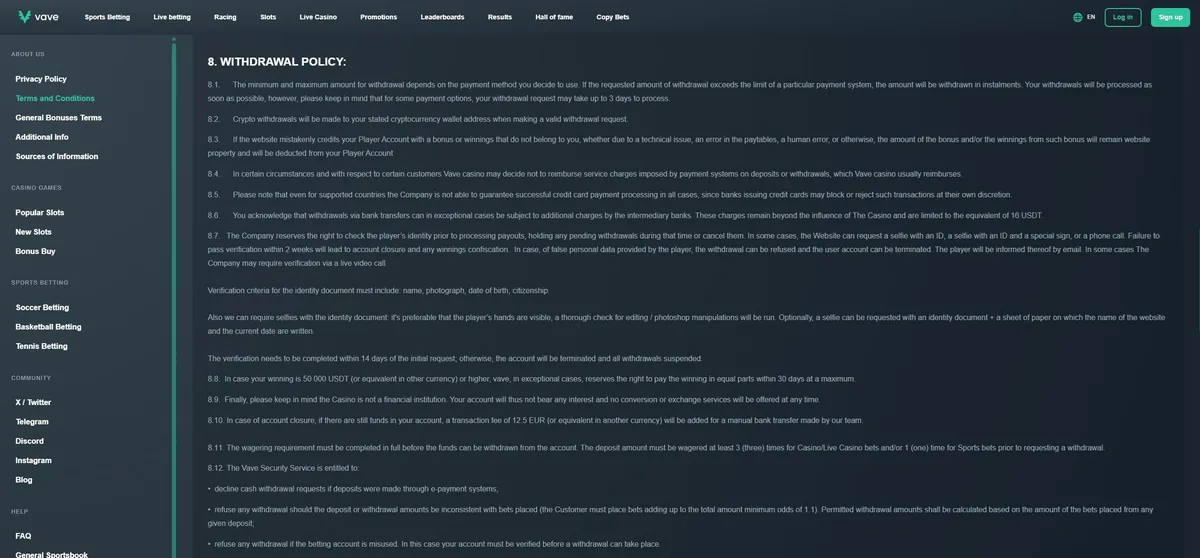
Clause 8.7 allows an identity check before any payout, with 14 days to comply. Clause 8.8 allows a win of 50,000 USDT or more to be paid in instalments over 30 days. Clause 8.11 requires the deposit to be wagered three times before a withdrawal.
The twelve operators and the Irish licence gap
There are twelve operators on this site.
All are offshore, and none holds or can hold an Irish licence from the Gambling Regulatory Authority of Ireland (GRAI). The Gambling Regulation Act 2024 created the GRAI, and the authority took over oversight in March 2025. That means an Irish player using any of these twelve sites is dealing with a company that answers to a foreign licence, not an Irish one. The Irish licensing timeline is explicit. The GRAI opens its first remote applications in February 2026 and issues its first remote licences from July 2026. That first phase covers betting, not online casino games. Online casino games remain outside that first remote licensing window. A player reading a crypto casino no KYC Ireland search result should know that the phrase does not point to a licensed Irish product. The absence of an Irish licence has a practical consequence. When a dispute arises, the player cannot take it to the GRAI as the regulator of the operator. The operator sits under a different jurisdiction. The licence page sets out that difference in more detail. For verification clauses, the regulator gap means the clause on the operator’s own site is the only text that governs. The verification clause is quoted, not summarised, for all twelve crypto casinos in Ireland read here, because the wording is the only thing that binds either side.
Threshold clauses name an amount
Three operators on the list name an amount at which verification is triggered. Bitcasino.io uses a verification threshold, clause 6.6. Rocketpot uses a verification threshold, clause 11.4. Sportsbet.io uses a verification threshold, clause 6.6. A threshold reading means the clause names an amount. That amount is the point at which the operator can require documents before a withdrawal proceeds.
None of the three clauses promises that amounts below the threshold will never be checked. The terms reserve the right to ask at any time. The threshold is not an exemption; it is a published trigger. A player who keeps withdrawals under a named amount may still be asked for identification if the operator decides the risk requires it. The clause simply narrows the discretion and makes one part of the policy readable.
The cash-out ceilings are separate from the verification thresholds, but they often sit near each other in the documents. Bitcasino.io sets a weekly cap of 1,000,000 USDT, clause on file. Rocketpot lists a monthly cap of 5,000 USD, clause on file. Sportsbet.io does not publish a separate withdrawal cap in the material read. The cap fixes the maximum a player can withdraw in a period, not the point at which documents are requested.
The operators with risk-based verification clauses
The larger group uses risk-based verification. Vave clause 8.7; Wild Fortune, clause 18.1; DuckDice, clause Section 2; Empire.io, clause 5.4; Metaspins, clause 9.7; Oshi Casino, clause 12; PlayAmo, clause 12; Rainbet, clause 5.2 and 8.3; Shuffle, clause 4.1. A risk-based reading means the clause reserves discretion and states no figure. The operator decides what risk means, when it is high enough, and which documents prove it.
Its clause 8.7 is risk-based, which means the same silence applies. The operator does not publish an amount after which verification is certain. It does not publish a promise that verification will never happen. The clause allows Vave to ask for documents when its risk process says to ask, and the player cannot see that process.
There is no way to plan around a risk-based clause.
A player can keep every deposit small and every withdrawal modest, and the operator may still impose a check. The absence of a published amount is not a sign that the operator is lax. It is the opposite: the operator keeps the decision in its own hands. For nine of the twelve operators, that is the policy on the page.

An illustration. Gambling is for adults: set a deposit limit before you play and stop when it stops being fun.
Cash-out ceilings published by some risk-based operators
Even where verification is risk-based, some operators state a withdrawal ceiling. Wild Fortune writes a monthly ceiling of 15,000 EUR into its terms, clause on file. Oshi Casino specifies a daily ceiling of 4,000 EUR, clause on file. PlayAmo documents a weekly ceiling of 7,500 EUR, clause on file. Those figures tell a player how much money can move out in a given period, not whether a document check will appear first.
A ceiling without a verification threshold still leaves the important question unanswered. A player withdrawing under the ceiling may be asked for a passport. A player withdrawing above the ceiling may be paid without a document check, if the operator’s risk process sees no need. The two clauses operate on separate tracks. The absence of a threshold means the verification timing is invisible.
For the three threshold operators, the amount also doubles as a planning point. A player who wants to stay below a named verification trigger can read the clause and choose a withdrawal size. For the risk-based operators, even that planning point does not exist. The payments page explains how ceilings and checks often combine at the cashier.
Geo-restriction and how an operator places a player
Every operator here runs a restricted-country list.
The list is written by the operator, not by the Irish regulator. It names the countries from which the operator will not accept play. Ireland appears on no restricted-country list held here. All twelve operators accept players in Ireland. For Vave that comes from the partner confirmation rather than from a restricted-country list this site read itself; for the other eleven it comes from their own published lists, which do not name Ireland.
An operator establishes where a player is through several signals. The address given at registration, the country of the payment method, and the IP the session came from are the usual three. These are usually reconciled at the first withdrawal rather than at signup. A player can deposit and play without a location question, then find the question asked when money tries to leave the account. The terms generally allow the operator to check at any time.
When the answer comes back wrong, the terms say what happens: the account is closed, the balance is voided, and deposits are not always returned. The operator’s terms often add that a balance will be voided where a VPN is used to disguise location. There is no appeal, because the operator holds no licence in the country it refused. An Irish player may never see this clause triggered, but the material explains what it costs a player elsewhere. The restricted-countries clause has not been individually confirmed and the reader should read the terms before depositing.
What the GRAI timeline does and does not change
The Gambling Regulation Act 2024 created the Gambling Regulatory Authority of Ireland. The Authority took over oversight in March 2025. It opens its first remote applications in February 2026 and issues its first remote licences from July 2026. That phase covers betting, not online casino games. For a player searching crypto casino no KYC Ireland today, none of those dates has yet produced an Irish-licensed crypto casino.
The first remote licences in July 2026 will not cover online casino games. The phase is restricted to betting. Online casino games remain outside that first remote licensing window. It is not published on this site when online casino games will enter the Irish licensing system. A reader should treat any claim that an Irish crypto casino licence exists now as unsupported by the Act’s timeline.
The GRAI’s powers apply to operators that hold or seek an Irish licence. The twelve operators on this site are offshore and do not hold an Irish licence. The GRAI cannot write their terms, cannot alter a verification clause, and cannot order a refund under a clause the operator wrote. Until an Irish-licensed online casino exists, the only enforceable terms are the operator’s own. The rankings page lists them side by side without pretending an Irish licence is present.
Reading the clauses before you deposit
The clause number beside each operator is the only reliable entry point. A reader who opens the terms and searches for clause 8.7 at Vave, clause 6.6 at Bitcasino.io, or clause 11.4 at Rocketpot can verify the reading directly. Where a clause states no figure, the absence is the point. The page does not fill the silence with a guess. It reports that no amount is published.
The phrase crypto casino no KYC Ireland itself is a search term, not a feature. No operator on this list uses those words in its terms. What the terms contain is a collection of verification triggers, some named, most discretionary. A player who arrives expecting a no-document promise will not find one. A player who arrives expecting to see where the clause goes quiet will find exactly that.
For an Irish player, the practical question is not whether documents will ever be asked, but at what point. The threshold operators give a number; the risk-based operators do not. That single difference is the boundary between a policy a player can plan around and one they cannot. The bitcoin casino pages show the same split across other crypto casino listings on this site.